Showing posts with label Science. Show all posts
Showing posts with label Science. Show all posts
Tuesday, 13 August 2013

Wednesday, 17 April 2013
Young Scientists At Work:What could this be?
Today,Yu Xuan brought a dead leaf with some queer-looking substances found at the underside of the leaf. What could this be? Could this be the eggs of an insect?
Are you able to crack the mystery here?

If you find something interesting around you which piques your interest, do bring it to class to share your findings with your classmates! It's a great way of learning together as a class.
Let's thank Harini for bringing a glass pyramid to class so that we can observe how a pyramid looks like and thank Yu Xuan for putting the effort to prepare an interesting specimen from the nature for us to explore. I yearning to see more of such interesting findings from you!
-Miss Dee-
Tuesday, 9 April 2013
6 States of Matter and Measuring Volume
Hi Children!
This is what we have covered for today. I need you to read through and reflect upon the following:
1) Other states of mater:
Fourth State: Plasma
Fifth State: Bose-Einstein state of matter
Sixth State: Quantum spin liquids
2) Online Classroom Debate
Should we include all sixth states of matter into our school textbooks? Are you primary 4 pupils able to learn all six states of matter? What is your stand on this? Why?

3) Measuring volumes for solid
Solid could be categorised into two different groups - regular solids and irregular solids. To measure volume of regular solids, we can apply the mathematical formula : Base area x Height. To find out the volume of irregular solids, we can use the displacement method (as mentioned by Harini during class). When you put an object into the cylinder filled with water, the water is being displaced (or pushed out) by the object.

4) Measuring volumes for liquids
On the other hand, liquids vary in viscosity. Some liquids are more viscous (thick) while some are less viscous (thin or watery). Examples of highly viscous liquids include melted chocolate, ketchup and oil while. Examples of less viscous liquids includes water, milk and soy sauce.
Measuring instruments to measure volumes include the measuring cylinder, micropipette, burette and syringe.
5) Measuring volumes for gases
We can use a gas syringe to measure volumes of gases. But could you think of other ways to measure volumes of a gaseous substances like air?
6) Create a measuring cylinder
Today, we learnt about how scientists invent the measuring cylinder. Is Albert Einstein the one who invented the measuring cylinder? Not all scientists are the same. We should respect them and appreciate their efforts in sharing their inventions to improve our lives. Without the invention of the measuring cylinder, how is it possible for future scientists to work with chemicals to produce new products such as perfumes and oil? Who invented the measuring cylinder, then?
 Albert Einstein is one of the greatest inventors to date. Here's a meaningful quote from him, " Try to become not a man of success, but try rather to become a man of value. - Albert Einstein". Sometimes success isn't about everything, what is most important is our values - to be exact, he is referring to our moral values or our character as a person. What does this quote means to you?
7) How to read volumes of liquids accurately using measuring cylinder
First, we need to level our eyes with the water level of the liquid and locate the meniscus of the liquid (curvature of the liquid).

8) Experiment: Liquids has a definite volume but no definite shape.
We learnt that liquid takes the shape of the container. We also know that the volume of a liquid can' be changed.
If you have further questions about today's lesson, please feel free to leave your questions in the comment box below.
A little treat for all of you...
Here's a video on how coke in its liquid state could turn into ice (solid state) instantly upon shaking.
This is what we have covered for today. I need you to read through and reflect upon the following:
1) Other states of mater:
Fourth State: Plasma
Fifth State: Bose-Einstein state of matter
Sixth State: Quantum spin liquids
2) Online Classroom Debate
Should we include all sixth states of matter into our school textbooks? Are you primary 4 pupils able to learn all six states of matter? What is your stand on this? Why?

3) Measuring volumes for solid
Solid could be categorised into two different groups - regular solids and irregular solids. To measure volume of regular solids, we can apply the mathematical formula : Base area x Height. To find out the volume of irregular solids, we can use the displacement method (as mentioned by Harini during class). When you put an object into the cylinder filled with water, the water is being displaced (or pushed out) by the object.
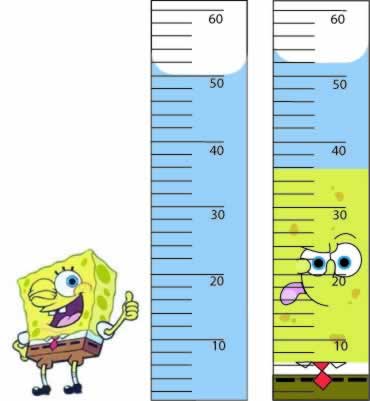
How about measuring the volume of spongebob?
4) Measuring volumes for liquids
On the other hand, liquids vary in viscosity. Some liquids are more viscous (thick) while some are less viscous (thin or watery). Examples of highly viscous liquids include melted chocolate, ketchup and oil while. Examples of less viscous liquids includes water, milk and soy sauce.
Measuring instruments to measure volumes include the measuring cylinder, micropipette, burette and syringe.
5) Measuring volumes for gases
We can use a gas syringe to measure volumes of gases. But could you think of other ways to measure volumes of a gaseous substances like air?
6) Create a measuring cylinder
Today, we learnt about how scientists invent the measuring cylinder. Is Albert Einstein the one who invented the measuring cylinder? Not all scientists are the same. We should respect them and appreciate their efforts in sharing their inventions to improve our lives. Without the invention of the measuring cylinder, how is it possible for future scientists to work with chemicals to produce new products such as perfumes and oil? Who invented the measuring cylinder, then?

7) How to read volumes of liquids accurately using measuring cylinder
First, we need to level our eyes with the water level of the liquid and locate the meniscus of the liquid (curvature of the liquid).

8) Experiment: Liquids has a definite volume but no definite shape.
We learnt that liquid takes the shape of the container. We also know that the volume of a liquid can' be changed.
If you have further questions about today's lesson, please feel free to leave your questions in the comment box below.
A little treat for all of you...
Here's a video on how coke in its liquid state could turn into ice (solid state) instantly upon shaking.
Wednesday, 27 March 2013
Our sugar canes!
Our sugar canes are growing!


What does this tell you about growth of plants? Do all plants have to start growing from seeds? =) On top of that, what do you observe about the roots? What are the names of different types of root systems?
http://www.botany.uwc.ac.za/ecotree/root/roottypes.htm
Fluffy has become a moth!
Fluffy has finally become an adult!
It took him about 2 weeks to grow from a caterpillar into a moth. Rich's guess was correct. Fluffy is a moth instead of a butterfly.


Tuesday, 26 March 2013
Science Lesson: What's the MATTER with everything?
Good evening Young Scientists of Primary 4/7!
I believe that all of you had a great time playing the Science quizz together as a class. Remember, winning is not everything but the effort to win is!
Below is my presentation slides for this lesson. Do feel free to look through them again to revise what we have learnt for today.
Lesson : What is Matter?
Videos
How to prove that air occupies space?
What is it like to do a somersault in outerspace?
Aspiring to become an astronaut? Click here to find out how you could be the next astronaut. You will have to work doubly hard and be in a state of good health to become an astronaut. Start studying and exercising today!
Put on Your Thinking Cap
After today's lesson, I would like you to think through the following questions and leave a comment below this post.
1) Besides energy and shadow, what else is not considered a matter in this universe?
2) What is vacuum?
3) How do we prove that water occupies space?
4) Sun is a matter which is consists of heat energy and gases like hydrogen and helium. So, how light is the Sun? What is the mass of the sun?
5) Xue Ying shared with us one way of measuring the volume of the liquid in the bottle given only a beaker (100 ml). Can you think of other ways of doing so?
If you have any other questions relevant to what we have covered for today, please do leave a comment below with your questions. If you know answers to some of your classmates' answer, you could also leave a reply or response under their comments.
Here's a quote for today!
"Science is a cemetery of dead ideas." - Miguel de Unamuno
There are constantly new discoveries made in the field of science. Some of the ideas are dead because they no longer stay true anymore.Like what I've mentioned in class, there are many things in the universe which are not yet discovered. Even til today, no one knows how gravity is being form and why it exists. Could you be the next scientist to find out why?
- Miss Dee -
I believe that all of you had a great time playing the Science quizz together as a class. Remember, winning is not everything but the effort to win is!
Below is my presentation slides for this lesson. Do feel free to look through them again to revise what we have learnt for today.
Lesson : What is Matter?
Videos
How to prove that air occupies space?
What is it like to do a somersault in outerspace?
Aspiring to become an astronaut? Click here to find out how you could be the next astronaut. You will have to work doubly hard and be in a state of good health to become an astronaut. Start studying and exercising today!
Put on Your Thinking Cap
After today's lesson, I would like you to think through the following questions and leave a comment below this post.
1) Besides energy and shadow, what else is not considered a matter in this universe?
2) What is vacuum?
3) How do we prove that water occupies space?
4) Sun is a matter which is consists of heat energy and gases like hydrogen and helium. So, how light is the Sun? What is the mass of the sun?
5) Xue Ying shared with us one way of measuring the volume of the liquid in the bottle given only a beaker (100 ml). Can you think of other ways of doing so?
Here's a quote for today!
"Science is a cemetery of dead ideas." - Miguel de Unamuno
There are constantly new discoveries made in the field of science. Some of the ideas are dead because they no longer stay true anymore.Like what I've mentioned in class, there are many things in the universe which are not yet discovered. Even til today, no one knows how gravity is being form and why it exists. Could you be the next scientist to find out why?
- Miss Dee -
Tuesday, 12 March 2013
Fluffy is growing!

We found Fluffy last Friday, 8th March. It was still a caterpillar then. Initially, we were still worried that we were not giving it the correct food when it did not seem to be active. To our surprise, it turned into a pupa over the weekend! It is still currently at the 3rd stage of its life cycle before it becomes a butterfly. How long will it take to become a butterfly? Would it be a moth instead? We wonder...
Subscribe to:
Posts (Atom)